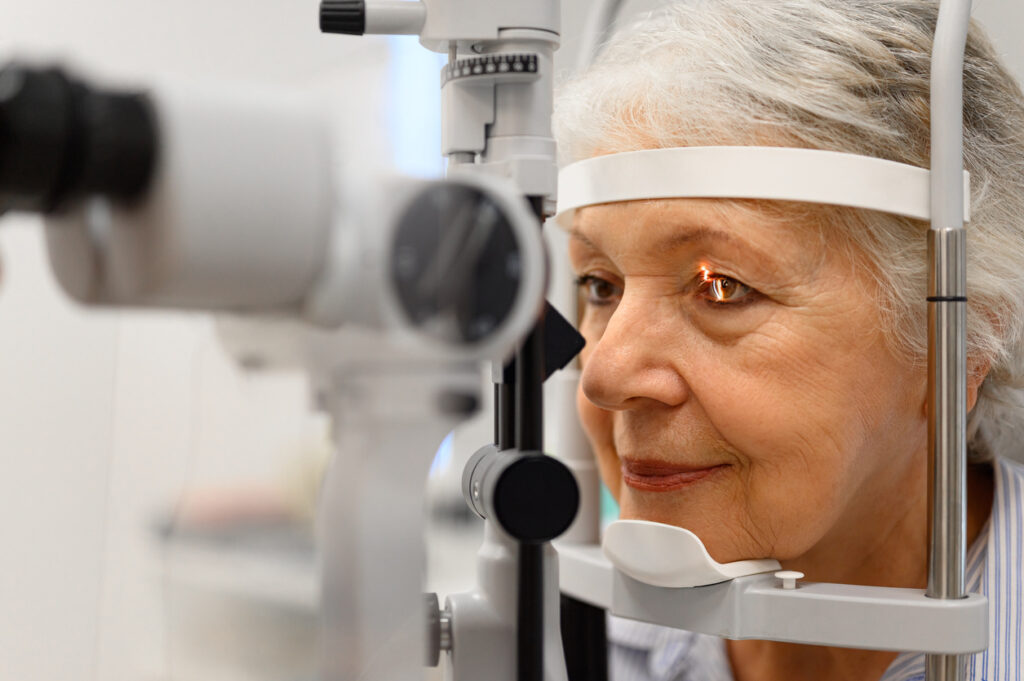
Blurry or hazy vision that is worse when you first wake up may point to a problem with the cornea’s inner cell layer. At Milwaukee Eye Surgeons in Brookfield, WI, our corneal care includes evaluation and treatment with Kenneth Weinlander, MD, a board-certified ophthalmologist and fellowship-trained cornea specialist. When Fuchs’ dystrophy becomes more advanced, our corneal treatment options include procedures that treat damaged endothelial tissue.
What Happens With Fuchs’ Dystrophy?
Fuchs’ endothelial dystrophy affects the endothelium, the cornea’s innermost layer. These cells normally help move excess fluid out of the tissue so the cornea stays clear. As their function declines, fluid can build up and create haze or swelling.
Early symptoms are often worse in the morning. Some people experience blurry vision after waking that improves later in the day. Glare, halos around lights, light sensitivity, and increasing cloudiness can also occur. If the condition progresses further, the blur may last longer and discomfort can develop.
Several eye problems can cause similar complaints, so symptoms alone cannot confirm Fuchs’ dystrophy. During a comprehensive eye exam, we can examine the cornea and determine what may be contributing to the change in sight.
How Does Fuchs’ Dystrophy Change Over Time?
Fuchs’ dystrophy progresses slowly, although the timing and severity differ from person to person. In earlier stages, morning haze may be the main concern. As endothelial cells lose function, the cornea may stay cloudy for more of the day.
Cataracts can also cause blurry or cloudy vision, and the two conditions may occur together. When that happens, evaluating both the lens and cornea is important before planning cataract surgery or corneal treatment.
What Treatments Are Available?
Care depends on how much the endothelium has been affected and how symptoms interfere with daily life. Mild cases may sometimes be managed with saline drops or ointments used to draw excess fluid from the cornea.
When surgery becomes appropriate, we perform DMEK and DSAEK, forms of endothelial keratoplasty that replace unhealthy inner corneal tissue with donor tissue. We also perform Descemet’s stripping only, or DSO, for select patients. DSO removes diseased endothelial cells without donor tissue and uses prescription eye drops to support healthy cell growth. A full-thickness transplant may be considered when more of the cornea is involved. Our article on who may need a corneal transplant explains these procedures.
Corneal Evaluation in Brookfield, WI
Morning haze, glare, or persistent blurry vision can have several causes. If these changes are affecting your sight, schedule an appointment with Milwaukee Eye Surgeons in Brookfield, WI, or call 414-377-5550. Our team can determine if Fuchs’ dystrophy is involved and explain which level of care fits your corneal health.